Showing posts with label 1974. Show all posts

Monday, June 26, 2023

Santana - Borboletta (1974)

Dan: 

Borboletta follows closely in the footsteps of Caravanserai and Welcome, using Santana's tried-and-true formula. It's more like Caravanserai than Welcome, but all three albums are part of the band's peak period. None of them should be missed, especially by listeners only familiar with Santana in the 1980s and beyond. The 70's run is fully conceived and executed, blending subtle opening and closing passages that sound like insects on a warm night, tight vocals, and (best of all) extended jam-like suites featuring Carlos at his soaring best.

On Borboletta, the sequence beginning with "Here and Now" through to the end lasts about 16 minutes and is worth every second. "Here and Now" serves as a halting-tempo prelude building expectations that soon become realized by the faster-paced "Flor de Canela," driven by percussion and sustained by long chords from the electric piano, organ and guitars. After a little over two minutes, "Promise of a Fisherman," the centerpiece of the album, comes on gloriously. The temperature rises over the steady pulse to climax ecstatically during its 8-minute length. It's one of the most exciting aural adventures I've ever experienced in rock and roll. 

I'm envious of anyone who has not heard the Santana albums reviewed in this blog. They get to hear them for the first time!! 

Also recommended are Lotus, a 3-LP set of live recordings from Japan (1974), and Moonflower, a part-studio, part-live recording (1977). These serve as valuable cappers to a fertile period that was bound to end. 

Steve: 

When we decided upon the list of albums to review in this blog, I noticed that for some reason, I had never acquired a copy of Borboletta. Although I remember it being in Dan's collection, I wasn't sure what any of the tracks sounded like. Being old-school, I held off on listening until a few days later, when a used vinyl copy magically appeared on my doorstep. Thanks Discogs!

It turned out I did remember most of this album. Although Caravanserai, Welcome, and Borboletta represent the sweet spot of Santana's most exploratory period, each has its unique flavor. If Caravanserai was a cosmic search through a spiritual desert, and Welcome was the resulting spiritual awakening, then Borboletta feels like a celebration of the natural world. The brief opening and closing pieces feature percussion and nature sounds by guests Airto Moreira and Flora Purim. The R&B/Soul influences are more pronounced, with "Give and Take", "Life is Anew", "One with the Sun", "Practice What You Preach", and "Mirage" all featuring smooth jazz/soul vocal arrangements. Even the titles of the aforementioned tracks reflect a desire for harmony with nature. I have been in the mood for 70s R&B lately, so this goes down especially well.

The instrumentals, comprising about half of the album, continue the advances made on Welcome. I agree 100% with Dan as to the intoxicating power of "Promise of a Fisherman" - the rhythm track bubbles over like a boiling cauldron, maintaining intensity for its duration. Tom Coster (keyboards) and Carlos Santana (guitar) both contribute dazzling extended solos. Welcome to jam band heaven.

I still have some catching up to do on this album, but I'm glad this blog finally prompted me to grab my own copy. No Santana collection is complete without it!

Sunday, June 25, 2023

Hatfield and the North - Hatfield and the North (1974)

Steve:

When discovering the bands considered within the "Canterbury Scene", there were two things that made it especially enjoyable: first, the bands had a great sense of humor (or humour, as they call it) and knew how to make even their instrumentals hilarious; and second, many of the same people kept appearing on these albums, giving the impression that you were now part of a cool club of eccentric Brits who were having a ton of fun and inviting you to join in. Once I had discovered Caravan, the next logical band to tackle (thanks to the CD liner notes that helped guide me) was Hatfield and the North, which included vocalist/bassist Richard Sinclair from Caravan.  

Despite this preparation, I was still surprised at the unique personality of Hatfield and the North once I heard their debut release. Pianist/organist/composer Dave Stewart immediately stood out as a strong instrumental voice, contributing jazzy instrumental pieces that changed constantly and conveyed an attitude of anything-goes fun and amusement, much like Frank Zappa's more playful instrumental works. On guitar, Phil Miller sounded like no one else, combining Eric Clapton's love of thick distortion and clean articulation with a jazzer's touch around complex chord changes. Richard Sinclair (pictured) further confirmed his ability to play with jazz chops, while contributing occasional vocal pieces that were disarmingly wry and goofy while containing complex changes of their own. Last but not least, Pip Pyle proved himself the perfect drummer for this outfit, as his rhythmic instincts were in sync with the band, and his own compositions added a bit of experimental flair to the album ("The Stubbs Effect", "Shaving is Boring", the latter of which appears to enter a sort of dream-state in its mid-section).  

I can't quite remember the first time I heard this album, as my post-Caravan discovery happened quite quickly, but Hatfield and the North has remained on my top shelf of prog rock records, to the extent that I cited it as "my favorite Canterbury album not by the Soft Machine". High praise that, if you know me. 

Dan:

After Steve had introduced me to this band, I was visiting London and saw a highway sign directing drivers to Hatfield and the North. That must have been the inspiration for the band as they sat around wondering "what should we call ourselves?" Having exhausted the limited variations on the Caravan theme (Caravan, Camel), why not pick the next convenient traffic sign? After all, random naming had worked for The Grateful Dead who picked their name on the first stab at an encyclopedia page. 

Both of the albums I know about (the self-titled debut and the follow-up The Rotters Club from 1975) are joyously zany while exhibiting exceptional musicianship. as Steve reports. The song "Share It" on Rotters Club is the one I remember the best, thanks to Richard Sinclair's fine vocals. 

The wacky song titles on Hatfield and the North do, quite honestly, make it difficult to remember the tunes so my practice is not to worry about where songs begin and end or what they're named. Like the long Caravan suites, it's better to sit back and go with the aural flow. 

Hatfield and the North reunited for a live performance in 1990, which is available on CD and DVD. The concert includes both old favorites like "Share It" and "Underdub" as well as new pieces. It's worth checking out. Also, Richard Sinclair formed a group called Caravan of Dreams, which released a self-titled album in 1992 and the live An Evening of Magic (1993). These are proof that the Canterbury scene lasted well beyond its heyday in the 1970s.

Saturday, June 24, 2023

Gong - You (1974)

Steve:

Gong remain one of the most beloved progressive rock bands from their time. They combined the goofy whimsy of the Canterbury bands (leader Daevid Allen was an original member of The Soft Machine) with the sci-fi austerity of heavier bands such as Magma. Gong may have seemed a bit off-the-cuff with their whimsy, but they also were serious world-builders with a fantasy/science fiction concept adding thematic unity and weight to their vision.

You represents the climax of what I consider the band's second phase - the first phase had been quite raw and almost garage-rock, while the second phase brought in more skilled musicians, particularly guitarist Steve Hillage and percussionist Pierre Moerlen, both of whom would eventually lead prolific bands of their own. 

My initial experience with Gong was a bumpy one. The first album I heard was in my college radio station's record collection, Expresso (the US equivalent of Gazeuse!), which is a fantastic mallet percussion-based jazz fusion album from the late 70s with Allan Holdsworth on guitar. Expresso was entirely unrepresentative of their "classic" prog period. My second Gong album was an archival CD (The History and Mystery of the Planet Gong), consisting of a variety of radio sessions and random live recordings from the 60s focusing on the early Daevid Allen-led material as well as some of his later solo material in the 70s. In short, the two albums represented entirely different bands, and I admit to being confused at the time. Back in those days, you took what you could find.

Eventually, the Radio Gnome Trilogy albums (now acknowledged as the backbone of the Gong legacy) became available on CD, and it became clear why Gong was so highly regarded in progressive rock circles. You is the last chapter in this trilogy, and the instrumental fireworks detonated on this album represent some of the finest space rock of its era. More furiously paced than Pink Floyd, more complex than Hawkwind, and more lyrical than Tangerine Dream, You combines the best of all three and then stamps it with their own whimsical personality.

You begins deceptively - the first two tracks are short vocal tracks operating in silly mode, but then the album escapes the Earth's atmosphere, never to return. "Master Builder" is the first major piece, a repetitive droning riff in an odd meter, over which Moerlen superimposes swift polyrhythmic drumming and the rest of the band offer exciting sax and guitar solos. "A Sprinkling of Clouds" is a showcase for synth player Tim Blake, who builds beguiling layers of overlapping lines to create a hypnotic rhythm, eventually ushering in the rest of the band who turn it into a space groove to die for.  

"The Isle of Everywhere" begins side 2 with more patient pacing - not so much a race through the stars as a pleasant float through the cosmos. Finally, "You Never Blow Yr Trip Forever" finishes the album with the first vocals since the beginning of the record, offering a relatively tough rock edge across another long-form piece.  

You's combination of driving space rock and jazz fusion soloing puts it in a unique class among its mid-70s progressive rock peers. Its innovations would later inspire the likes of such insanely prolific modern bands as Ozric Tentacles, Acid Mothers Temple, and even techno/electronica bands, proving their ongoing relevance well beyond the 1970s progressive rock scene. Among the classic prog bands, only Can has been more influential on music from the 80s onward.

For a naïve yet more thorough overview of Gong, you could do worse than read the overview I wrote for Exposé over 20 years ago and which has been memorialized on the Gnosis web site: Gnosis2000.net - Gong

Dan:

Thanks to Steve, I have three Gong albums in my collection: You, Gazeuse!, and Shamal. You is my favorite, although I have a sentimental attachment to Gazeuse! and the now absent Expresso II because I used to have those LPs back in the 70s. You see, I'm attracted to the sound of the vibraphone within a jazz context. Pierre Moerlen is an excellent vibes player and he apparently reshaped Gong into a jazz fusion group. You more accurately summarizes the multifarious phases of Gong in one terrific album.

It's also a very likeable album. Although that may sound like faint praise, I am often turned off by records that I have to work too hard to appreciate. There's nothing superficial or "lite" about the music on You. I prefer to think of it as a logical progression of a band that consolidates their early goofiness with their later instrumental prowess. 

Friday, June 23, 2023

Franco Battiato - Clic (1974)

Steve:

Franco Battiato stands as an important figure in Italian music - he is well known in his country as a wide-ranging singer/composer from the early 1970s through to his death in 2021. He had success in a number of styles, including electronic music, new wave, symphonic works, movie soundtracks, and even opera. At the start of his career in the early 70s, he was a key figure in an unusual avant garde scene that combined Italian folk music, electronic experimentation, progressive rock, and musique concrète.  

I first heard of Franco Battiato well into my forties via the ProgArchives website and forum. In the late '00s through the early '10s, I spent a good chunk of my free time on music forums, and for a few years I was on ProgArchives all the time. Although not a prolific reviewer, I eventually became an active participant in the running of the site itself, in addition to interacting with others on the forum. There were tons of knowledgeable music fans from all over the world on that forum, and I had gotten to know some of them well and came to trust their recommendations. 

Battiato's first two albums, Fetus and Pollution, caught my attention initially with their striking artwork. Once I listened to them, I felt I'd discovered a new type of music that directly resonated with me: music made with fairly primitive means, using strange new technology in previously unforeseen ways, with abundant imagination, and conveyed by a great singing voice. 

All of Battiato's first four albums are classics of Italian progressive music, and Clic, the fourth, is my favorite, although I'm not sure many Battiato fans would agree with me on that pick. By this point, Battiato's music was turning more abstract, relying more on electronics and musique concrète, with very few vocals. The main draw of this album as I see it is how a clear human personality can be felt and understood within these pieces - even through the usually cold detachment of the avant-garde medium. Somehow, I feel this guy. His free association of musical and sonic ideas strikes me as very intuitive. I'm not sure how transferable that feeling is but give it a try if you're curious.

Dan: 

I was eager to play this album even though Steve was hesitant to include it. As you can tell from his comments, it means a lot to him so I was extra curious. Fortunately, most of the devices used by Battiato are familiar to me, having understood early John Cage, some computer-generated music of the 80s, and of course "traditional" prog (if that's not too contradictory of a term). The dedication of the album to Stockhausen seems appropriate. 

Of course, synthesized sounds became commonplace in the world of rock during the 80s, so music like that on Clic could be seen as a resource for artists like Phil Collins, Steve Winwood, and many others. Instrumental synth artists became very popular, especially Kitaro and Vangelis, with the latter's lush movie soundtrack albums. Clic is not like any of these derivatives, but rather a set of procedures that could be used by almost any later genre.

What I like the most about Clic is its mystery, made even more mysterious by my inability to understand Italian language. It definitely feels like it's about "something," but it's not describable in any literal sense. I don't really need an explanation because Clic impacts in other ways. It has a definite form and shape, as opposed to random noises sometimes offered in avant-garde music. It grows on me with every new listen.

I do appreciate Battiato's variety of techniques. His use of a string quartet augments the electronic devices skillfully, especially on "Propiedad Prohibida." The use of background voices conversing, chanting and singing during "Nel Cantiere Di Un'Infanzia" and "Ethika Fon Ethica" (the last two parts) is reminiscent of John Zorn's wonderful tribute to Italian film composer Ennio Morricone, The Big Gundown (1988). Zorn inserted dialog from Morricone's films into a thickly concocted musical stew. You can read my review of The Big Gundown at MORE FAVORITES: Reflections on Jazz in the 1980s: Search results for big gundown (jazzinthe80s.blogspot.com)

The 1988 reissue of Clic is faithful to the original 1974 issue. Apparently, there were LP versions that compiled parts of Clic with other music. I'm happy to discover Clic  and welcome it into my collection. 

Thursday, June 22, 2023

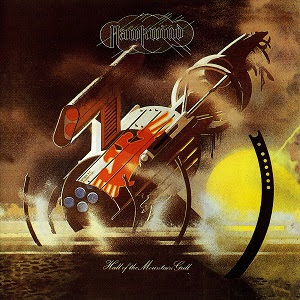
Hawkwind - Hall of the Mountain Grill (1974)

Dan:

To paraphrase a common reviewer cliché, if you have room for only one Hawkwind album in your collection, make sure it's Hall of the Mountain Grill. (Maybe make room for Space Bandits too). Those are among the few Hawkwind offerings that I have spent any time with, but I'm glad to have been exposed to this band. Further exploration into their astounding discography of 96 albums between 1969 and 2023 is beyond my reach. 

I had read a bit about Hawkwind in the British jazz magazine The Wire. They covered relevant rock bands and were excited about Hawkwind. Steve, as usual, was way ahead of me and gladly loaned me some of his Hawkwind CDs. It didn't take long for me to home in on Hall of the Mountain Grill, which satisfied my need completely. I also got a lot from Space Bandits (1990), mostly from the first three tracks: "Images," "Black Elk Speaks," and "Wings."

Hall of the Mountain Grill
is a coherent suite of songs that manifest hard rock sensibilities alongside more prog-like music. Violins, synthesizers, saxes, kalimbas, mellotrons and flutes all find their way into Hawkwind productions. I prefer to think of their approach as progressive rather than space-rock, which is how they're often typed, but I'm also not interested in playing the classification game. (As Duke Ellington once said, there are only two kinds of music - good and bad.) 
Hawkwind are unique and consistently good. Leader Dave Brock clearly knows what he wants from the band and each album succeeds on his own terms. To me, Hall of the Mountain Grill sounds like their pièce de résistance.

What I like most about Hall is the contrast between the individual songs, which flow naturally as part of a suite (another telltale prog sign). Thus, we begin with the rocking "The Psychedelic Warlords (Disappear in Smoke)" which segues into the mysterious "Winds of Change," which precedes the rocking "D. Rider," and so on to the end. Some of the instrumentals appear to be conceived as transitions, such as the title track and the lovely "Goat Willow." The rock songs are great, especially "Lost Johnny" and the closer "Paradox," but their impact is enhanced dramatically by the shorter tracks featuring wind sounds, acoustic piano, and flute. In other words, Hall of the Mountain Grill is a wonderfully conceived album, not just a set of rock songs. I'd recommend it to the faint of heart who might normally avoid noisy metal bands. Hawkwind can rock with anybody, but on Hall of the Mountain Grill, at least, they created something special for all to enjoy. 

Steve: 

Hall of the Mountain Grill was the first Hawkwind album I came across in a CD store, and thus was the first one I bought. It's a little hard to know if it's my favorite of their albums because it was my first or because it really is the best. I did learn later that this album is very highly regarded in their discography among fans, so I consider myself lucky that it happened to be the first one I saw. All these years later, I've acquired another dozen or so Hawkwind albums, and every one of them is entertaining, which is the sign of a band that knows its job and gets it done.  

"D-Rider" (track 3) is possibly my favorite Hawkwind song - it was written and sung by sax player and second vocalist Nik Turner, and I've discovered that many of my favorite moments from the original Hawkwind lineup were driven by his macabre proto-New Wave sensibilities (see also "Brainstorm" and the classic "Masters of the Universe"). Hall of the Mountain Grill works extremely well as a unified piece, as it flows organically from start to finish, making it an easy continuous listen with no dull patches.  

Wrap Up - Our Final Post

We've reached the end of our project, having posted joint reviews of 130 albums and including comments on many others as part of our com...