Showing posts with label 1968. Show all posts

Tuesday, May 16, 2023

Al Kooper & Mike Bloomfield - Super Session (1968)


Dan:

I first heard guitarist Mike Bloomfield on the Paul Butterfield Blues Band's magnum opus, East-West (1966). It was recommended by my primary jazz resource, Downbeat, and kindled my interest in electric 
bluesmen like B.B. King, Muddy Waters, and Buddy Guy. East-West was a classic due largely to two long instrumental tracks: the title tune and Nat Adderley's "Work Song." Both featured Bloomfield's amazing guitar work. 

I considered it essential to acquire Super Session, which promised more extended jams by Bloomfield. I wasn't entirely sure who Al Kooper was, other than the leader of a band called The Blues Project. Stephen Stills was a member of Buffalo Springfield, and I knew their hit single "For What It's Worth," but David Crosby, Stills and Graham Nash were yet to form as a group. That was okay because I only wanted to hear more Bloomfield.
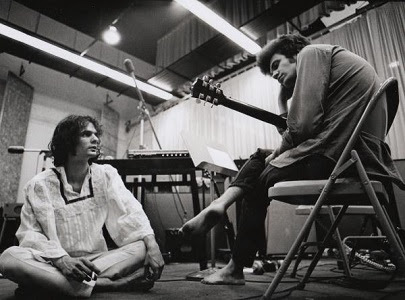
As hoped for, there's plenty of blues jamming on Super Session. Right out of the gate we get "Albert's Shuffle," co-written by Kooper and Bloomfield. It's almost 7 minutes long and exceeds any expectations I might have had. Kooper plays organ, and Barry Goldberg from The Electric Flag is credited with electric piano, although he's not featured. Side 1 continues with more long instrumentals with the exception of Kooper's lone vocal on Curtis Mayfield's "Man's Temptation." 

Side 2 changes the line up to exclude Bloomfield and include Stills. It includes songs by Bob Dylan, Donovan, and Willie Cobb. Although it is disappointing to lose Bloomfield, it's still a strong group. Bloomfield was known for his chemical dependency, dying from a drug overdose in 1981. Failing to complete an album was not uncommon in the days when drugs were rampant. Bloomfield is also missing on Side 3 of The Live Adventures of Mike Bloomfield and Al Kooper (1968), giving way to guests Elvin Bishop (from the Butterfield Blues Band) and Carlos Santana. 

Some tracks on Super Session are augmented by a horn section. As Kooper explains on the sleeve notes: "The music on this record was performed spontaneously by the personel (sic) as listed above. The horns were added later as an afterthought." Normally, I cringe at overdubbing but in this case it works superbly. 

Steve:

This was never an album I latched onto specifically, though I learned about Mike Bloomfield early in life via the Butterfield Blues Band's East-West album. On one occasion, Dan, I and my friend Abram were exploring "great guitar solos" and playing each other examples we knew. I remember that I offered "Free Bird" as one of my examples, but the most memorable one was offered by Dan: Mike Bloomfield's solo on the track "East-West". This 13-minute instrumental begins with a couple minutes of decent but workmanlike solos by Elvin Bishop and Paul Butterfield, and Butterfield's builds to a climax that introduces Bloomfield, who immediately produces a "holy shit!" effect (try it for your friends and watch the hair on their arms stand up) and proceeds to dazzle for most of the remainder of the track. [Dan's Comment: the other entries in my "great guitar solos" competition were Eric Clapton on "Crossroads" (Wheels of Fire) and Steve Hackett on "Firth of Fifth (Selling England by the Pound).]

Years later, I became a huge fan of Al Kooper, and find him eminently dependable as a producer/arranger of impeccable taste, particularly on his 1970s albums recorded under his own name. None of these albums sold many copies, but they were all made possible by the fact that Super Session was such a huge success. Kooper has always been great at choosing interesting outside material and arranging it in a way that is respectful of the original but always adds something new. He's not a particularly gifted vocalist, but somehow his performances always capture just the right mood.  

To illustrate his expert touch on recordings he produced, I read in the liner notes of the expanded reissue of Super Session that the horn overdubs, natural though they sound, were put in there largely to help cover up various dropouts and sonic imperfections in the original recordings. Kooper, amused at fans' longtime wish to hear the songs without the overdubs, offered a couple of them as bonus tracks on the CD. Honestly, the non-horn versions sound pretty clean to me -- but that just goes to show how sensitive an ear Kooper had/has. If I were making an album, he's one of the people I would want in the producer's seat. I recently read his memoir, Backstage Passes and Backstabbing Bastards. If the sardonic point of view inherent in that title appeals to you, I think you owe it to yourself to give it a read.

Monday, May 15, 2023

Procol Harum - Shine on Brightly (1968)

Steve:

In our earlier post about Procol Harum's self-titled debut album, I mentioned that the albums immediately following the debut were the ones I identified with the most. Of those, Shine on Brightly is my favorite, hands down, and a treasured album that I know by heart, listen to often, and would most likely place on an all-time-favorites list. On this album, guitarist Robin Trower gets a bit more space to play his expressive leads, and the band experiments with song structures that match the literary ambitions of the lyrics -- the beginning of prog as we know it!

The first 2 1/2 songs follow the template of the debut album - tuneful & concise songs driven by Procol Harum's unique piano/organ mixture, Gary Brooker's rich vocals, and Keith Reid's striking lyrical themes. Where these songs depart from the debut album's template lies in Robin Trower's increased presence; in between the vocal lines, his thickly distorted guitar interjects similarly to Eric Clapton's playing on the Cream albums. This adds to the music's weight and introduces a new melodic element to enhance the already colorful songwriting.  

At the midpoint of the third song, "Skip Softly (My Moonbeams)", things start to get strange. The first half of the song was a fun, whimsical oom-pah oom-pah music hall number (albeit with howling lead guitar), but a transitional section leads it down into a completely different, darker space. The remainder of the song (all instrumental) goes from moody, dark ambience to a one-note guitar solo, a false ending, then a sudden jump into a super-fast coda that sounds like circus music at 45 RPM. This is a hint that this album is trying out new stuff. From there, even relatively straight songs are delivered in ways the band hadn't shown us before: "Wish Me Well" is a straight blues tune turned psychedelic thanks to Trower's wailing guitar, and "Magdalene (My Regal Zonophone)" avoids rock entirely in favor of a church chorale arrangement.

The tour-de force takes up most of side 2 and is arguably the first multi-part progressive rock epic: "In Held Twas in I". This was the first song I remember hearing by Procol Harum - Dan must have had a copy of it on tape, and at a young age I was mystified by it. The suite's title is an acrostic: it was derived by stringing together the first word from each section of the piece. It begins with a long spooky narration and goes through several very different sections to a climactic conclusion with choir (pre-Atom Heart Mother!) in about 17 minutes. It's the perfect capper to a near-perfect album.

Dan:

I remember getting this album when it came out, just about the time Steve was born. It must have been the LP he heard at a very early age since I didn't have any taping equipment and CDs were to follow more than 10 years later. I love "In Held Twas in I," which begins with the recitation "In the darkness of the night only occasionally relieved by glimpses of Nirvana..." and ends with the Dalai Lama's advice to the seeker of the meaning of life. "Well, my son, life is like a beanstalk, isn't it?" Other phrases from this opening narrative, such as "wallowing in a morass of self-despair made only more painful by the knowledge that all I am is of my own making," still drift into my mind at odd times. 

"In Held" also contains a second narration that is more cryptically disturbing than humorous. And the part of the suite titled "Autumn of My Madness" lays it out expressly as the troubled lyrics perfectly match the anguished chords. The title track is also about madness. This obviously dark foreboding appears often in Procol Harum's recordings. Hey, this is the band that wrote about shipwrecks! 

Sunday, May 14, 2023

The Moody Blues - In Search of the Lost Chord (1968)

Dan:

Having been spellbound by Days of Future Passed, I eagerly awaited each new Moody Blues album. In Search of the Lost Chord came out in 1968 and I thought it was even better than the previous album. It was a glamorous gatefold single LP with lots of cool artwork and band pictures. It had a couple of catchy tunes that received a lot of air play ("Ride My See-Saw" and "Voices in the Sky"), and it dabbled harmlessly in psychedelic topics on "Legend of a Mind" while also advising that "thinking is the best way to travel." Basically, In Search of the Lost Chord is Moody Blues optimism tinged by Buddhist symbols (a mandala is included with the album and "Om" is the closing chant-like song). Just what the world was ready for in 1968.

The opening "Departure" is a strange but fascinating way to begin any rock album. A low chord sounds and a voice speaks nonsense in a progressively loud manner culminating in a shout that leads into the bombastic "Ride My See-Saw," which almost seems like a joke. But the lyrics reveal this to be the beginning of an escape from the problems of the material world:

My world is spinning around,
Everything is lost that I found.
People run, come ride with me,
Let's find another place that's free.

From there we're led to a meeting with "Dr. Livingstone, I Presume" and the "House of Four Doors," both evidence that the search is underway. Side 2 finds the search moving in a positive direction, away from despair and Timothy Leary's pills. With "Visions of Paradise" on the horizon, "The Actor" assumes responsibility for finding the lost chord which is, as we've already guessed, "Om".

While expressing the need for search, the album stops short of elaborating on the reasons for flight. There were plenty of reasons to escape in the 1960s, but the Moodies avoided the kinds of vitriolic social critique that, say, Jefferson Airplane engaged. 

Some may find the Moody Blues and their optimism too Pollyanna-like: 

Visions of paradise, cloudless skies I see
Rainbows on the hill, blue onyx on the sea
Come see. 

But the underlying message is one of a better future within our grasp. I can't argue against the value of an optimistic outlook or the importance of self-understanding. 

Steve: 

I regret that I have never paid particular attention to the lyrics of the Moody Blues (or most bands, for that matter), as I've always had trouble focusing on lyrics in general - even if I can understand the words being sung. I'm often distracted by the words as sounds as opposed to what ideas they are trying to convey, unless they are either very obvious (e.g. Pink Floyd's The Wall) or are the undeniable focus of the work (e.g. Bob Dylan's Blood on the Tracks). I am, however, very sensitive to instrumental texture and chord changes, as well as the intricacies of song structure in general, and the Moody Blues always offered much to enjoy on those fronts.  

The Moody Blues' orchestral ambition as revealed on Days of Future Passed was no passing fancy. Their success on that project gave them license to become a self-contained orchestra themselves by taking on additional instrumentation and pushing the limits of multi-track recording available to them in 1968. They added sitar, tabla, tympani, cello, saxophone, and harpsichord to their already diverse list of instruments. I'm especially fond of the sitar/tabla stuff - I can gladly listen to sitar music for hours on end (I just bought another Ravi Shankar album the other day, in fact), so I am particularly happy that the album ends with "Om", a song that takes me to my happy place every time.  

One more aspect I love about this album, and about the prime-era Moodies in general, is how the band encouraged each member to share in the singing and songwriting, making their albums a revue of sorts showcasing the different personalities in the band. Typical of the pattern of their albums of this period, this one begins with a Graeme Edge poem ("Departure"), segues into a melodic rock song with hit potential ("Ride My See Saw"), follows it up with a more offbeat quirky song by Ray Thomas ("Dr. Livingstone I Presume"), and continues the unpredictable variety by alternating the different voices, song styles, and personalities throughout the album. I love when a band can boast that kind of versatility -- not many bands in rock history have been able to.

Saturday, May 13, 2023

Spirit - Spirit (1968)

Dan:

Spirit's first eponymous album was a revelation to me when I first heard it in 1968, the year of its release. It's been in my possession (in various formats) ever since. It's initial appeal for me was the jazz influence, but quickly I grew to appreciate everything about it (tracks, lyrics, instruments, production, cover, etc.). It's kind of like a best friend who never leaves you (like some human best friends do). I didn't need to understand Spirit's members, their inspirations, and their legacies. All of that was irrelevant to what I considered to be a perfect album.

As years passed, I acquired the next Spirit albums, The Family That Plays Together, Clear, and Twelve Dreams of Dr. Sardonicus. All of them had great tracks, but they were more like my best friend's siblings - close but not the real thing. Later, Steve (who has researched and written about the band elsewhere) fed me some of the later Spirit albums - Spirit of '76 (1975), Son of Spirit (1975), and Farther Along (1976). I enjoyed listening to them during a single afternoon, but they were like hearing a different band. I blame myself for only wanting one best friend, but what's a boy to do?

Without getting too far into the weeds of analyzing every track, Spirit consists of ten short songs, ranging from 2:11 to 5:14 minutes, followed by "Elijah," a jazzy jam that lasts 10:49 minutes. Each of the single-length songs is perfect. They're each musically unique, loaded with clever lyrics, and performed at medium intensity - neither over- nor under-cooked. Most of them appear to be written about strange people - "Water Woman," "Girl in Your Eye," "Uncle Jack," "Straight Arrow," "Mr. Gramophone Man." The first track, "Fresh Garbage," makes a political statement ("The world's a can for your fresh garbage"), a theme revisited on Sardonicus' wonderful "Nature's Way."

The closing "Elijah" gives each band member a chance to show off their talents as soloists. Perhaps predictably, there are no pyrotechnics on display from this laconic ensemble, which knows how to reach the listener without bombast. Compare Spirit's "Elijah" with Blind Faith's "Do What You Like" and you will understand the point. 

Steve:

I remember being fascinated by Spirit from the moment I heard this album. Dan was playing it for me when I was in my early teens, and I was very amused by "Fresh Garbage" ("look beneath your lid some morning / see those things you didn't quite consume") and the band photo on the back (see above), where it looked like each guy was from a different band. The band's music was equally eclectic - was it blues rock, folk rock, jazz rock, classical rock? All of these elements are here on Spirit, in combinations few bands have attempted since.

Unlike Dan, I have become attached to each of the first four classic albums equally, and in recent years my fandom has expanded deeply into the 70s edition of the band (with only two original members) and beyond, including a spinoff band called Jo Jo Gunne that produced three fine (and one so-so) albums of their own. But Spirit always comes up when deciding which is my absolute favorite. It's totally unique, even in the context of the Spirit discography, and that gives it a magical aura none of their other albums can match.

Wrap Up - Our Final Post

We've reached the end of our project, having posted joint reviews of 130 albums and including comments on many others as part of our com...